
Bear Flag Revolt begins in California on June 14, 1846
June 14, 1846 — On This Day in the American West™
The Bear Flag Revolt Begins in California
On June 14, 1846, a small group of American settlers rode into the Mexican town of Sonoma, arrested General Mariano Guadalupe Vallejo without bloodshed, and raised a hastily made banner depicting a grizzly bear and a single red star. The action marked the beginning of the Bear Flag Revolt, one of the most famous—and controversial—episodes in the history of the American West.
At the time, California was a remote northern province of Mexico, sparsely populated and only lightly governed. Yet thousands of American emigrants had begun arriving overland, encouraged by reports of fertile valleys, abundant resources, and the growing belief that the United States was destined to expand from coast to coast. Tensions between Mexican authorities and the increasing number of American settlers had been rising for months.
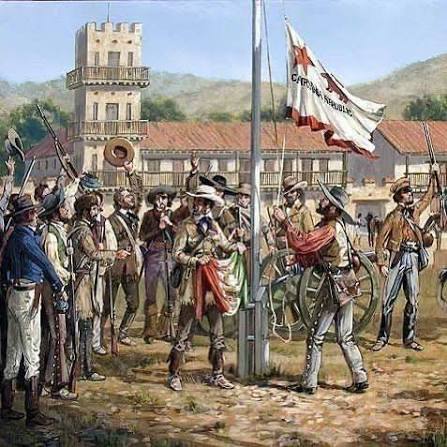
The rebels, numbering little more than thirty men, feared that Mexican officials planned to expel foreign settlers from the region. Acting on that belief, they seized Sonoma, captured several military officers, and declared California an independent republic. They adopted a homemade flag featuring a crude image of a grizzly bear beneath a lone red star, giving the uprising its enduring name.
The so-called California Republic, however, proved remarkably brief. It existed for only twenty-five days. Unknown to many participants, the United States and Mexico had already entered into war weeks earlier. On July 9, 1846, U.S. naval forces formally occupied the region, the Bear Flag was lowered, and the American flag was raised in its place. California's independent republic disappeared almost as quickly as it had been created.
The revolt nevertheless became a turning point in the conquest of California. Combined with American military operations during the Mexican-American War, it accelerated the transfer of California to the United States, a change formally recognized in the Treaty of Guadalupe Hidalgo in 1848. Just two years later, the discovery of gold at Sutter's Mill would transform California into the gateway of the American West and draw hundreds of thousands of newcomers from around the world.
Although historians continue to debate the exact role played by explorer John C. Frémont and the extent to which the revolt was spontaneous or quietly encouraged by U.S. officials, there is little doubt about its lasting symbolism. The grizzly bear flag raised over Sonoma on June 14, 1846, evolved into one of the best-known emblems of the American West and inspired the design of the modern California state flag.
What began as the actions of a handful of settlers in a frontier town ultimately helped reshape the political map of North America and opened the door to the rapid American settlement of the Pacific Coast.
Image: Lowering the Bear Flag and raising the United States flag at Sonoma, California, on July 9, 1846, marking the end of the short-lived California Republic created by the Bear Flag Revolt that began on June 14. Sonoma Library via Wikimedia Commons — Public Domain.
Sources: Hubert Howe Bancroft, History of California (1886); H. W. Brands, The Age of Gold (2002); National Park Service, Mexican-American War and California Campaign; California State Library; California Military Museum.